
The calls that come in after midnight in Springfield are rarely about a healthy oak. Far more often they are about an ash: a tree the owner had been meaning to deal with, standing bare for a second summer, that finally let go in a wind that would not have troubled anything else in the yard. Dead ash trees fail differently from other dead trees, and the crews who answer those calls plan around that difference before they ever start a saw.

Why ash is the tree that fails in the middle of the night
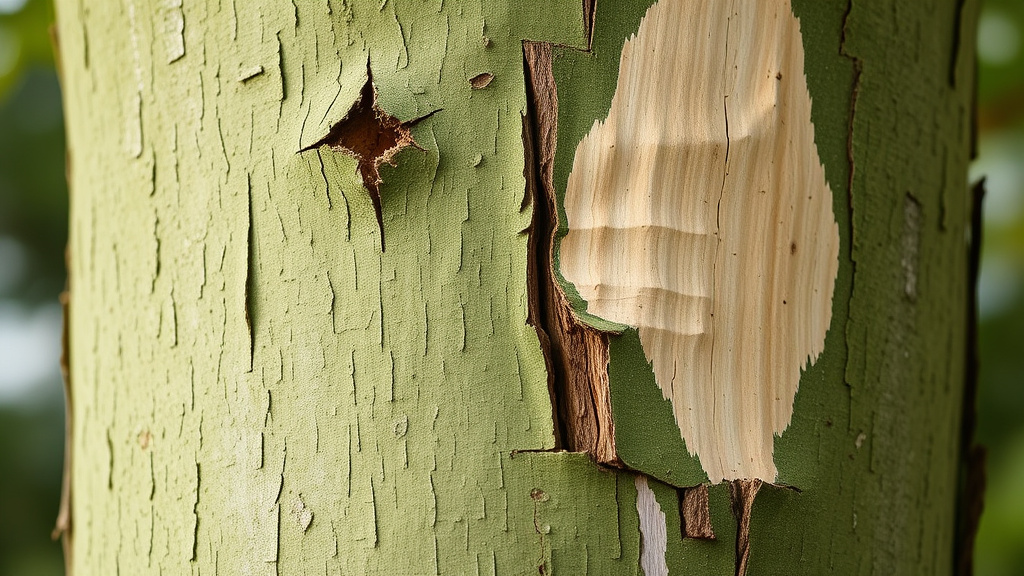
Fairfax County traces the emerald ash borer to packing material that arrived in North America in 2002, and the beetle has since spread through the northeastern United States, including the county. The county's own description is blunt: without treatment the insect infests and kills all ash tree species, and an infested tree typically dies within about three years as the larvae block the movement of water and nutrients under the bark. The signs the county lists are the ones a Springfield owner can check from the lawn: D-shaped exit holes, vertical splits in the bark, woodpecker feeding that strips the outer bark pale, a thinning canopy, and sprouts breaking out along the trunk.
What makes the dead ones an emergency rather than a chore is a single sentence on the county's page: ash trees affected by the borer may randomly fail faster than other trees because of brittle wood. A dead oak can stand for years and give warning. A dead ash drops limbs and tops without one, and the wood is unpredictable under a climber's weight, which is why crews treat a standing dead ash as a rigging problem rather than a climbing one.
What an emergency crew does first in a Springfield yard
The first minutes on a night call are about what the tree has landed on and what is still holding it up. If any part of the tree is touching a power line or a service drop, the crew stops and the utility is called; Dominion Energy's instruction is that a limb on a line is theirs to remove and that downed lines and anything near them should always be assumed to be energized. Only once the line is confirmed clear or de-energized does the tree work start.
Next is the house. A trunk resting on a roof has to be lifted off in pieces, not rolled, because the point of contact is what is keeping the rest of the tree from sliding. Crews rig the sections to a crane or an anchor and take weight off the structure in a planned order. The remaining standing portion of a dead ash is treated with the same suspicion as the part that fell: it is brought down from the ground or from a bucket wherever the lot allows, and the stump is left for daylight.
Reading the trees that have not failed yet
Most emergency removals in Springfield are preceded by a year or two of visible warning. The county's advice is to manage dead ash proactively rather than wait, and the practical question for an owner is which trees on the lot are ash at all. Many were planted along streets and in back corners of lots as fast-growing shade and were never identified. A county-level guide to spotting the species, confirming the infestation and deciding when a tree has crossed from treatable to hazardous is laid out in Dead Ash Trees in Fairfax County: When Removal Can’t Wait, and it is the reading to do before storm season rather than after it.
The Springfield lots where the risk is highest
The ash that fails onto something is usually the one at the edge of the woods, where no one looked at it closely. Springfield has a lot of that edge: the lots backing onto the Lake Accotink Park trail system, the stream-valley strips along Accotink Creek and its feeders, and the wooded buffers behind the older subdivisions. A walk on the four-mile loop trail at the county park on Accotink Park Road shows what the beetle does to an unmanaged ash population; on a private lot, the same kind of tree is a hazard with a house under it.
Because the county stopped giving tree-canopy credit for ash on development sites and asks residents to plant other native species, an ash that comes down in Springfield is replaced with something else. The county also asks that firewood not be moved; a dead ash cut into rounds should be burned or chipped where it fell rather than carried across the county.
Who answers the call
G&V Tree Service has been a family-owned company in Springfield since 2001 and provides emergency storm response alongside its scheduled work. Every crew is led by ISA certified arborists trained to ANSI A300 standards; the company is a member of the Tree Care Industry Association and the International Society of Arboriculture, it is licensed and insured, and it does not subcontract, so the crew that arrives at night is the same one that comes back to grind the stump. On-site estimates are free. Two related pieces on this site cover how post-storm recovery work is sequenced and what a tree risk assessment looks at before a storm.
Starting at the lake, ending on Brandon Avenue
Lake Accotink Park, at 7500 Accotink Park Road, with its four-mile loop trail and the dam-side stretch that the county warns floods in heavy rain, is the landmark most Springfield residents know best; the G&V Tree Service office on Brandon Avenue sits a short drive away, and the directions between the two are below.
G&V Tree Service Inc · 6434 Brandon Ave, Suite 204, Springfield, VA 22150 · (703) 569-2570
Questions owners ask on the night of a call
The tree is on the service wire to the house. Who do I call first? The utility. Dominion removes limbs that have fallen onto its lines and asks that no one else try; a tree crew works the rest once the line is dealt with.
Can a crew climb a dead ash to take it apart? Crews avoid it. The county notes that borer-killed ash fails unpredictably because the wood is brittle, so the tree is taken down from the ground, a bucket or a crane.
Is a bare ash in October already dead? Not necessarily, but a thinning canopy, bark splits, pale woodpecker damage and trunk sprouts together are the county's listed signs of infestation, and an arborist can confirm it on site.